
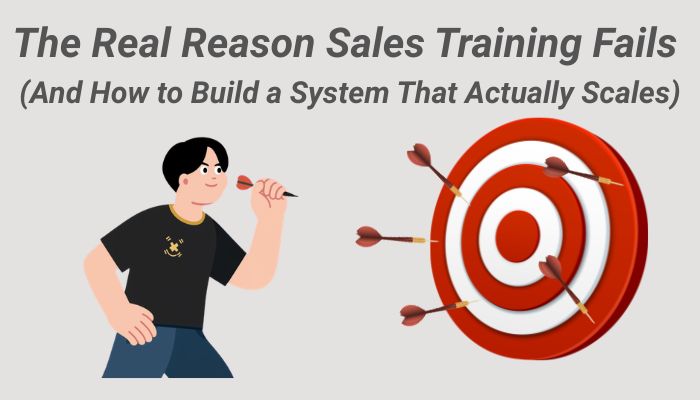
Why Most Top-Rated Sales Training Programs Fail to Stick
The search for the best sales training is the wrong starting point — and that’s exactly why most programs don’t move the needle.
Every year, sales leaders invest thousands per rep in workshops, certifications, and keynote-driven boot camps. The content is solid. The speakers are compelling. And then, within weeks, almost nothing changes. That’s not a content problem. It’s a retention problem. Gartner research shows that sales reps forget 80–90% of what they learned within one month when there’s no systematic reinforcement in place.
This is the forgetting curve in action — and most programs ignore it entirely.
There’s a second failure hiding beneath the surface: the hero performer trap. Training delivered as a one-time event tends to benefit the reps who were already strong. They absorb the new frameworks, adapt them instinctively, and close more deals. The rest of the team watches and falls further behind. Training doesn’t level the playing field — it widens the gap.
The deeper issue is the distance between learning a skill and executing a process. A rep can articulate a discovery question framework perfectly and still struggle to use it under pressure. Consistent execution doesn’t come from knowing what to do — it comes from having a repeatable system that makes doing it automatic.
That’s the shift most organizations haven’t made yet.
The Shift from Hero Culture to Scalable Sales Systems
The best sales training isn’t a curriculum — it’s a repeatable process that any rep can execute consistently.
Too many sales organizations are built around their top performers. When the team hits quota, it’s because two or three star players dragged the number across the line. That’s not a sales system. It’s a dependency. And it’s the single biggest reason growth stalls at scale.
Here’s the pattern: companies invest in top-rated sales training programs, reps get a skills boost, and the stars shine brighter. But the middle of the team stays flat. That’s because tactical training — workshops, scripts, and one-off coaching sessions — develops individual capability without building organizational infrastructure.
Execution frameworks work differently. They define the repeatable steps, decision points, and qualifying criteria that turn a team of average performers into a reliable revenue engine. The difference  isn’t motivation or talent. It’s structure.
According to the Salesforce State of Sales Report, high-performing sales organizations are 2.3 times more likely to provide their teams with a structured sales process. Structure isn’t a constraint — it’s the multiplier.
For mid-market and enterprise teams, a scalable sales framework gives managers something they can measure, coach against, and improve over time. That’s how growth compounds.
So before asking which program to invest in, ask a better question: what does “best” actually look like in practice?
What is the Best Training for Sales in 2026?
The best sales courses aren’t ranked by content quality alone — they’re ranked by what changes after the training ends.
Three criteria separate programs that stick from programs that get forgotten by Friday:
- ROI: Does win rate, deal size, or ramp time improve measurably within 90 days?
- Retention: Are reps applying the skills three months later, or reverting to old habits?
- Repeatability: Can any rep on your team execute the framework consistently — not just your top performers?
Professional sales skills training earns its place in a modern sales stack when it’s built around these standards. As Richardson Sales Performance notes, “The best sales training isn’t a one-time event; it’s a continuous process of reinforcement and coaching that is integrated into the daily workflow.”
That last phrase is the key.
The best training is the one wired directly into your workflow.
When reps log a call, they should be prompted to apply the framework. When a deal stalls, coaching cues should surface automatically. Training that lives outside the daily process gets skipped. Training embedded inside it becomes habit. Building a high-performance sales culture depends on that distinction.
With the right criteria established, the next step is to evaluate which methodologies actually meet that standard.
Evaluating Top Sales Training Methodologies and Certifications
Methodologies are tools, not systems — and the best sales teams treat them that way.
Challenger, Sandler, SPIN, and similar frameworks each solve a specific problem. Challenger pushes reps to re-frame buyer thinking. Sandler controls the qualification process. SPIN builds diagnostic questioning skills. When evaluated as components of a larger system, all of these have genuine value.
The mistake is treating any single methodology as the complete answer.
This same logic applies to certifications. Too many professional sales skills training programs hand out certificates for completion rather than competence. Just because a rep passes a test or exam at the end of their training doesn’t prove they can execute the method under pressure — they’ve proven they can absorb information. Certification should validate execution, not attendance. The standard needs to shift toward assessments that test applied skills: live role-plays, deal reviews, and observed calls.
One practical approach that addresses both problems is licensing an established framework for internal delivery. When your own managers and coaches facilitate the training, they control reinforcement, adapt examples to your market, and build accountability into the day-to-day rhythm. This is especially valuable if you’re already diagnosing pipeline health and gaps — your internal trainers can tie methodology directly to what’s breaking in real deals.
CSO Insights found that companies with a formal sales process see a 17% higher win rate. The methodology you choose matters less than whether it’s consistently embedded into your process.
That embedding is where most teams fall short — and it’s exactly what the next piece of this puzzle addresses.
Bridging the Gap: Moving from Training to Execution
Even the best sales training programs fail at the same place: the hand-off from classroom to call. Training creates awareness. Execution requires infrastructure.
Training without enablement is just expensive forgetting.
Sales enablement closes the loop. Reinforcement tools — such as call coaching, deal reviews, playbooks, and CRM prompts — keep skills active after the workshop ends. Without them, reps default to old habits within weeks. Research from XINNIX confirms that without structured reinforcement, most learning evaporates before it ever reaches a live deal.
Execution breaks when the process is missing, not when the training is. According to CSO Insights, teams with a formal sales process achieve 15% more quota attainment than those without one. Good training on top of a broken process just produces faster failure. The methodology has to land inside a system that supports it daily.
Rep turnover doesn’t have to reset your team. A scalable framework — documented stages, defined skill benchmarks, consistent coaching cadences — means a new hire ramps into a machine, not a mystery. Explore what a structured program built for scale looks like in practice.
Getting this infrastructure right is what separates a training event from a genuine performance system — and that distinction drives everything in the takeaways ahead.
The Bottom Line: Key Takeaways for Sales Leaders
When sales leaders ask “What is the best training for sales?“, the real answer is: the one that doesn’t stop when the workshop ends.
The patterns covered in this article point to one unavoidable conclusion — training events create awareness, but systems create performance. Here’s what that means in practice:
 Stop buying events, start building systems. A single training day is a spark. Without a system around it, the spark dies. Revenue growth comes from repeatable processes, not one-time programs.
- Reinforcement is non-negotiable. Research consistently shows that without follow-up, reps lose up to 90% of new information within days. According to Cerebral Selling, skill gaps compound quickly when reinforcement is absent. Spaced repetition and coaching close that gap.
- Structured processes separate top teams from average ones. High-performing teams don’t rely on instinct. They run defined playbooks, consistent discovery frameworks, and clear qualification criteria — every rep, every deal.
- Certification means execution, not completion. A certificate that measures seat time is worthless. Measure observable behaviors on real calls and real opportunities instead.
Training investments only pay off when they’re embedded into how your team operates daily. If you want practical frameworks that go deeper, the next step is building the system that holds all of this together — which is exactly what’s coming next.
Building Your Unstoppable Sales Machine
The gap between sales training and sales results closes when you stop treating them as separate problems. That’s the premise behind the Unstoppable Sales Machine Framework — a structured approach that connects skill development directly to day-to-day execution, so what gets learned in the room actually shows up in the field.
Most teams are one or two hero performers away from a revenue crisis. When results depend on individual talent rather than a repeatable process, scale becomes impossible. The framework shifts that dynamic by building systems your entire team can execute consistently — not just your top 20%.
Long-term reinforcement is where most programs collapse, and it’s where the Unstoppable Sales Suite is built to stick. Rather than a one-time training event, the Suite provides ongoing coaching tools, accountability structures, and reinforcement resources that keep skills sharp and behaviors consistent across the full sales cycle.
If you’re ready to move from unpredictable performance to a scalable revenue system, explore the full framework here — or find out how to bring it inside your organization through a certified implementation program built for sales leaders who need results that last.
© Shawn Casemore 2026. All Rights Reserved.
Share This Article
Choose Your Platform: Facebook Twitter Google Plus Linkedin