
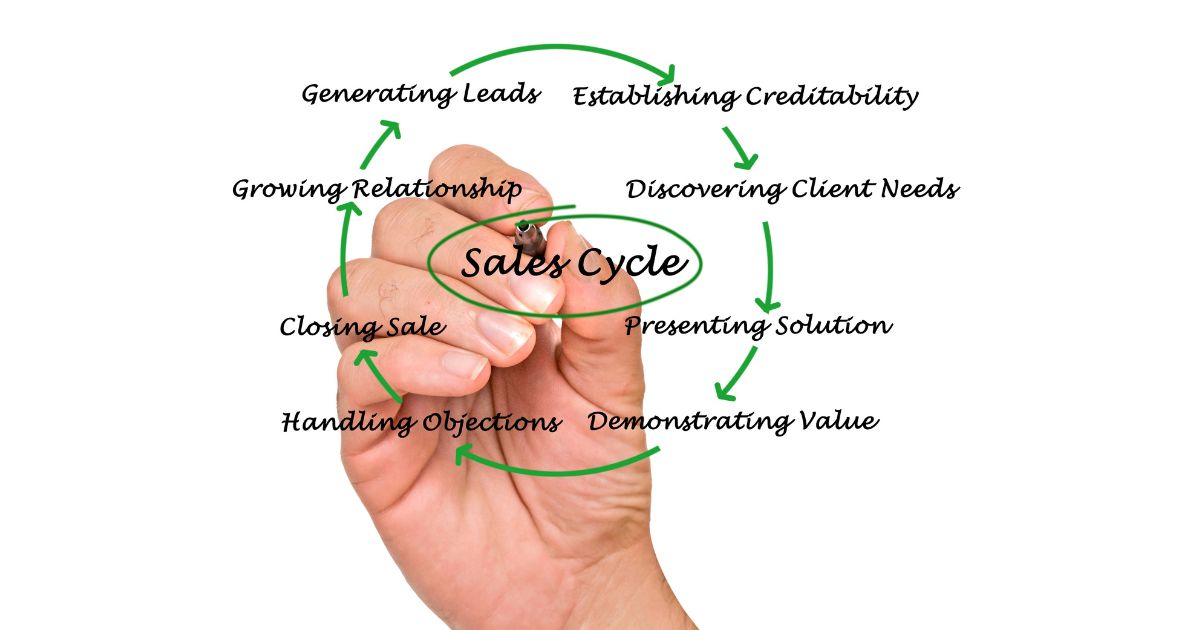
Step 1: Calculate Your Sales Cycle Length
Knowing how to reduce sales cycle length starts with one thing: an honest measurement of where you stand today. Without a baseline, your optimization efforts are wasted.
Calculate your sales cycle length as follows:
Total days to close all deals ÷ Number of deals.
That single number is your starting point.
Here’s how to turn that number into actionable intelligence:
- Run the formula across your last 90 days of closed deals. Use actual data (i.e., from your CRM) — not just gut feel.
- Identify dead time between each stage. Where do deals sit for days or weeks without movement? That stall point is where revenue leaks.
- Segment by lead source and deal size. Enterprise deals take longer to close than deals from small business or retail. Know the average numbers and address any outliers that distort your average and hide real problems.
- Set a North Star velocity metric. A single target cycle length your team rallies around. This becomes the benchmark for every improvement you make.
Once you have these numbers in hand, you’re ready to act on them. The next step is about preventing deals from drifting in those critical first few days — before momentum ever has a chance to stall.
Step 2: Implement the 3-3-3 Rule for Early Momentum
One of the fastest ways to shorten your sales cycle is to stop letting early-stage deals go cold. Applying the 3-3-3 rule is a high-intensity follow-up strategy built to do exactly that: Apply 3 touchpoints across 3 channels within the first 3 days of engagement.
Here’s how to apply it:
- Map your three channels. Choose an email, a phone number, and a social channel like LinkedIn. Each touchpoint hits a different context, so you’re not just pinging the same inbox repeatedly.
 Execute day one fast. Send a value-led email within hours of first contact. Reference something specific to their business — not a generic intro.
- Follow up by phone on day two. Leave a concise voicemail if there’s no answer. Keep it to 20 seconds and name a clear next step. A great message to leave is “I sent you some information by email but wanted to ensure you received it.”
- Engage on LinkedIn by day three. Comment on a recent post or send a connection request (with no message) if not already connected. This signals genuine interest.
- Score the response. Anyone who doesn’t engage across three channels in three days has a low urgency/interest. Flag them, lower your priority, and protect your team’s time.
- Align marketing touchpoints. Coordinate with marketing so any nurture emails or re-targeting ads reinforce — not contradict — what your rep just said. Buyers should feel supported, not bombarded.
Quick Tip: The 3-3-3 rule isn’t about pressure — it’s about building early deal momentum fast. Reps who wait five or more days to follow up see dramatically lower conversion rates.
Once you’ve filtered for genuine buyers with some degree of interest, the next challenge is keeping the internal buying process moving on their side — which is where buyer enablement tools come in.
Step 3: Deploy Buyer Enablement Tools for Group Consensus
Once you’ve built early momentum, the next obstacle is the buying group itself. According to Gartner, the average B2B purchase now involves 6 to 10 decision-makers, each working from independently gathered information. That internal misalignment is what stalls deals — not your pitch.
“The secret to shortening the sales cycle is to stop selling and start helping the customer buy.” — Sharon Drew Morgen
Shift your rep’s focus from presenting to facilitating.
Your champion can’t close their colleagues on their own — give them the tools to do it. This directly compresses your sales cycle length formula by reducing the back-and-forth that kills momentum in committee-driven deals.
Here’s what to arm every champion with:
- Action plan: A shared document mapping every step — from evaluation to signature — with owners and due dates on both sides.
- ROI calculator: A simple, editable spreadsheet your champion can run through with other stakeholders to demonstrate value without waiting for your rep.
- Internal pitch deck: A stripped-down, shareable version of your proposal built for an audience that’s never met your team.
- Objection and pricing FAQ: Address the hard questions in writing, early. Late-stage pricing surprises are often a top reason deals stall.
These assets turn your champion into an internal sales rep. Building a repeatable library of them — aligned to your proven close strategies — is exactly the kind of execution framework covered in this approach to high-impact selling.
The next step is making sure your entire team deploys these tools consistently — which is where standardization and automation come in.
Step 4: Standardize and Automate the Execution Framework
This step in the sales cycle tutorial is where most teams leave serious time on the table. Buyer enablement and early momentum mean nothing if your reps are executing inconsistently. According to the Salesforce State of Sales Report, high-performing sales organizations are 2.3 times more likely to have a structured, automated sales process than underperformers. Standardization isn’t a nice-to-have — it’s a velocity multiplier.
- Map every stage to a buyer milestone, not a seller activity. “Demo sent” isn’t a milestone. “Buyer confirmed budget and timeline” is. Restructure your CRM pipeline stages around what the buyer has done, not what your rep has done.
 Automate meeting scheduling. Every manual back-and-forth email to book a call adds days to your cycle. Use calendar automation to eliminate that friction entirely.
- Build automated follow-up sequences triggered by deal stage, not by rep memory. Consistent follow-up shouldn’t depend on who’s having a good week.
- Audit your CRM for friction points. If data entry takes more than 60 seconds per interaction, reps skip it. Streamline required fields to only those that actually drive forecasting decisions.
- Create a standardized “Unstoppable” execution checklist every rep follows at each stage. Document it. Train to it. Inspect it on deal reviews.
The result is a process that doesn’t rely on your top performer carrying the team — which sets up everything you need to maintain velocity long-term.
How to Maintain Sales Velocity: Key Takeaways
When you set up sales process infrastructure the right way, shorter cycles become a repeatable outcome — not a lucky quarter. Here’s what this guide covered:
- Use the 3-3-3 rule early. Build momentum in the first three interactions and disqualify low-intent leads before they consume your team’s time.
- Enable your internal champion. Buyer enablement tools give champions what they need to move consensus forward without you in the room.
- Standardize execution. Eliminate dependence on hero performers. A documented, repeatable framework scales results across your entire team.
- Measure cycle length monthly. Bottlenecks shift over time — a monthly review of your cycle length formula surfaces new friction before it compounds.
The reality is stark: Gartner research shows B2B buyers spend only 5% of their total buying journey with any single rep. Every touchpoint has to count. Teams that win aren’t more aggressive — they’re more organized.
If you’re ready to build a system that closes faster and scales without adding headcount, explore the Unstoppable Sales Machine framework.
© Shawn Casemore 2026. All Rights Reserved.
Share This Article
Choose Your Platform: Facebook Twitter Google Plus Linkedin