

The Myth of the Natural Closer: Why You Need a System Instead
Most sales leaders have experienced this. The rep who seems to close on instinct, who reads the room, says the right thing, and walks away with the signature, every time. These reps are invaluable — but they’re also a liability.
Relying on talent to drive revenue is not a strategy; it’s a dependency that breaks the moment that performer leaves, burns out, or has a bad quarter.
Closing isn’t a personality trait. According to the Salesforce State of Sales Report, high-performing sales organizations are 2.3 times more likely (than underperforming ones) to use a structured, repeatable process for closing conversations. That gap isn’t explained by who they hired. It’s explained by what they built.
The difference between a hard close and a value close comes down to whether the conversation is designed around the buyer’s confirmed priorities or around the rep’s pressure tactics.
Hard closes create resistance.
Value closes surface alignment. Best of all, a value close can be systematized, taught, and replicated across an entire team.
This is where most organizations discover the real problem: sales execution breaks when systems are absent. Training provides knowledge. A framework provides execution. When your closers are winging it — even successfully — you’re building revenue on a foundation that doesn’t scale.
The antidote? Give every rep consistent, well-chosen examples of closing questions that reflect where the buyer actually is in the conversation. The next section breaks down exactly which strategic questions do that work — and why they outperform generic closing lines every time.
Strategic Examples of Closing Questions That Confirm Value
The right sales closing questions examples don’t pressure buyers — they confirm that value has already been established and remove the final barriers to commitment.
The best closing question doesn’t expect a signature – it confirms that the prospect perceives value in what you’re sharing and what you’re proposing. That distinction matters.
When a closing question feels like a demand, it creates friction. When it feels like a natural checkpoint, it moves the conversation forward.
According to Gong.io, sales professionals who use targeted closing questions see a 15% higher win rate than those who rely on generic or aggressive closing lines. The question itself is a system input — and like any system input, the quality determines the output.
Here are three closing questions that consistently confirm value without increasing buyer friction:
- “Is there any reason we shouldn’t move this forward?”— This question surfaces hidden objections before they derail the deal. Instead of assuming alignment, you invite the prospect to name any remaining concerns, giving you the chance to address them directly rather than losing the deal silently after the call.
- “Based on what we’ve discussed, does this address your [specific challenge or goal]?”— A collaborative question that puts the business case in the buyer’s own words. When a prospect articulates the value themselves, they’re not being sold to — they’re arriving at a conclusion. That’s a fundamentally different psychological position.
- “What would make you feel comfortable moving forward with what we’ve discussed?”— This transitions cleanly from discovery to commitment. It respects the buyer’s decision-making process while creating a clear path to resolution, replacing assumptive pressure with genuine problem-solving.
The shift is from generic to targeted questions. It’s not a style preference—it’s a system choice. Generic closes like “So, are we good to go?” leave the buyer’s internal objections untouched. Targeted questions tie the close directly to the specific value conversation that preceded it, which is exactly the kind of repeatable, coachable behavior that scales across a team.
Once you understand why these questions work, the next step is knowing which technique to deploy and when — and that requires a structured playbook, not improvisation.
Mastering the 5 Essential Closing Techniques
Each closing question you deploy should match the specific moment in the conversation — the wrong technique at the wrong time creates friction, even if the words themselves are correct. These five techniques give sales teams a repeatable toolkit, not a script to recite.
- The Assumptive Close shifts the conversation from “if we move forward” to “when we move forward.” According to Richardson Sales Performance, asking about implementation timelines rather than the purchase decision itself reduces cognitive load on the buyer, making commitment feel like a natural next step rather than a high-stakes leap.
-
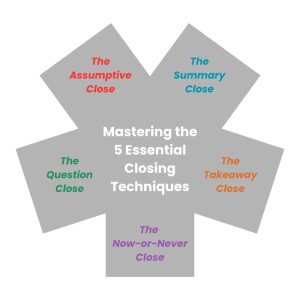 The Summary Close rebuilds momentum right before the ask. Restate the two or three outcomes the prospect confirmed they need, then connect those directly to your solution. You’re not repeating yourself — you’re helping the buyer hear their own logic back.
 - The Question Close leads the prospect to their own conclusion. Questions like “Based on what we’ve covered, do you feel this addresses what you described?” invite the buyer to confirm alignment rather than respond to a push.
- The Takeaway Close tests commitment by introducing controlled scarcity around fit, not just availability. Suggesting the solution may not be the right match at this stage — because of scope, timing, or readiness — surfaces real objection signals before they stall the deal later.
- The Now-or-Never Close carries genuine risk if misused. Reserve it for situations where urgency is real and already understood by the buyer. Manufactured pressure breaks trust; legitimate urgency tied to pricing, capacity, or timing reinforces it.
Once you’ve deployed any of these techniques, what happens next is just as critical as the technique itself—which is where silence becomes the most powerful tool in the room.
The Power of Silence: What to Do After You Ask
Asking strong closing questions is only half the skill — what you do in the seconds that follow determines whether the deal moves forward or stalls.
Using silence after a closing question is not awkward – it’s productive. According to analysis from Nethunt and Gong, top-performing sales pros wait an average of 3–5 seconds after asking a closing question before speaking again.
That pause isn’t passive — it’s strategic. The buyer is processing a genuine commitment decision, and any word you add during that window signals that you don’t trust the question you just asked.
Interrupting the silence is one of the most common ways a well-constructed closing question gets undermined. In practice, reps who rush to fill the quiet often end up answering their own question, introducing a new objection, or weakening their position by over-explaining. The result? The buyer never had the chance to arrive at “yes” on their own terms.
“The first person to speak after a closing question loses.” That’s a truth veteran sellers live by—and it holds because silence forces the buyer to make the next move.
Silence also functions as a diagnostic. If the buyer hesitates, their body language and first words reveal exactly where the real friction lives — price, authority, timing, or confidence in the solution. That information is only visible if you give it room to surface.
Maintaining poise during the pause is a discipline, not a personality trait. It can be trained. The Unstoppable Sales Machine Framework builds this into the execution layer — because scalable revenue systems don’t leave critical moments like this to individual instinct.
That kind of discipline connects directly to a broader question: when should a salesperson stop being open-ended entirely and force a definitive decision point?
Pro Tip — Handling Awkward Silence: Count silently to five before you consider speaking. If the buyer still hasn’t responded, reflect the question back calmly: “Take your time — what’s your initial reaction?” This keeps the decision in their hands without adding pressure.
Why Close-Ended Questions Are Essential for Closing
Open-ended questions build understanding — but every deal has a point where exploration must stop, and decision-making must start. That’s exactly where close-ended questions for business conversations earn their place.
At some point, the conversation has to demand a verdict, not invite more discussion.
According to Dialpad’s sales research, close-ended questions are most effective in the final 10% of the sales cycle, specifically to confirm agreement on concrete points. Before that threshold, they can feel pushy. After it, they’re necessary.
| Factor | Open-Ended Questions | Close-Ended Questions |
| Purpose | Uncover needs and context | Confirm decisions and next steps |
| Best timing | Discovery and mid-cycle | Final 10% of the sales cycle |
| Buyer experience | Exploratory, conversational | Direct, decisive |
| Seller benefit | Builds understanding | Creates clarity and commitment |
| Risk if overused | Delays forward momentum | Creates pressure too early |
Binary questions do something open-ended questions can’t — they force a decision point. A question like “Does this solution address the timeline challenge we discussed?” requires a direct answer. That answer either moves the deal into execution or surfaces the last real objection you need to handle. Both outcomes are productive.
For the buyer, that clarity is actually a relief. It ends the ambiguity that often stalls deals in a prolonged evaluation phase. For the seller, it eliminates the guesswork that comes from vague positive signals. The role of “yes” or “no” isn’t to pressure — it’s to give both sides an honest foundation for what comes next, whether that’s signing or solving a remaining concern.
Done right, this is where your closing framework becomes a system rather than a hope.
The Bottom Line: Scaling Your Closing Success
Every closing technique covered in this article points to the same conclusion: closing is a system, not a personality trait. The deals your top rep wins aren’t won because of charm — they’re won because that rep, consciously or not, follows a repeatable sequence of questions, pauses, and responses that moves buyers forward.
The problem is that most sales organizations never codify that sequence. They rely on intuition, hope their best people stick around, and watch win rates fluctuate with headcount changes.
Here’s what a standardized closing process actually delivers:
- Targeted questions increase win rates. Research from RingCentral confirms that targeted, situation-specific closing questions outperform generic ones — and standardizing the closing
 process allows for measurable performance management across the entire sales team.
 - The Assumptive Close reduces friction by shifting the conversation from “will you buy?” to “how do we implement?” — a subtle but decisive shift in buyer psychology.
- Silence after asking for the business is a deliberate tool, not a gap to fill. The rep who speaks first after a closing question typically loses leverage.
- Predictable revenue demands a repeatable framework. Without one, you’re not managing a sales team — you’re managing a collection of individual habits.
Closing success at scale isn’t about finding more hero performers. It’s about building a system that makes heroics unnecessary.
That’s the gap The Unstoppable Sales Machine Framework, including implementation consulting, the Unstoppable Sales Suite of programs, and a Certified Implementer licensing program, is built to close — and the next section shows exactly how it does that.
Building Your Unstoppable Sales Machine
Closing questions don’t fail because your reps lack talent—they fail because your organization lacks a system every rep can execute consistently.
That’s the core insight running through every section of this article. When closing breaks down, the instinct is to hire better, train harder, or wait for a star performer to carry the number. But those are short-term fixes to a structural problem. The Unstoppable Sales Machine Framework addresses the root cause: the gap between what your team learns and what they actually execute in the field.
The Unstoppable Sales Framework bridges the gap by moving organizations from sales training to repeatable execution systems. Programs are built around the mechanics of real deal progression — qualification, discovery, objection handling, and closing sequences — so reps don’t rely on improvisation or personality to get to yes. Implementation consulting goes further, embedding a structured closing system into your team’s daily workflow so that predictable revenue stops depending on a handful of hero performers.
If your closing results are inconsistent, the fix isn’t a better script. It’s a scalable system. Start with a free Unstoppable Sales Assessment to identify exactly where your closing process breaks down — and what a structured execution framework can do to fix it.
© Shawn Casemore 2026. All Rights Reserved.
Share This Article
Choose Your Platform: Facebook Twitter Google Plus Linkedin