

The Hidden Cost of the ‘Training Event’ Trap
Most sales performance problems aren’t training problems — they’re behavior problems that training events can’t solve.
The pressure on Sales VPs and Sales Directors to “fix” underperformance is an ongoing challenge. A quota miss triggers coaching, and too many misses often result in a familiar response: book some training, bring in a speaker, run the team through a two-day intensive. If everything goes as planned, the Reps leave feeling motivated, but weeks later, almost nothing has changed.
This is the Sales Training Event trap. It’s a cycle in which organizations invest in high-energy, high-cost learning experiences without building the infrastructure to turn that learning into consistent daily behaviours. The training feels productive. The outcomes aren’t.
The data supports this. Research consistently shows that up to 87% of sales training content is forgotten within 30 days without structured reinforcement. That means the majority of your training budget evaporates before it ever touches your pipeline. When you’re choosing sales training, this retention cliff should be the first problem you design against — not an afterthought.
The real shift leaders need to make is from measuring learning to measuring execution. Did reps complete the module vs are they running structured discovery conversations on every qualified call? The latter is the metric that predicts future sales. As we say at the Unstoppable Sales Machine: “Sales Training Doesn’t Fail. Sales Execution Breaks.” The gap between what reps know and what they do consistently is where most sales systems collapse — and it’s exactly the gap that systematic implementation is designed to close.
The sections ahead introduce a practical framework for evaluating whether a training program is built to drive repeatable execution — or just another event on the calendar.
Evaluating Sales Training Through the 5 C’s of Execution
Choosing the right sales training program comes down to one question: does it address how your reps actually execute in front of a buyer, or does it just teach them what they should say?
That distinction matters more than ever right now. Over 50% of large B2B transactions are expected to be digital self-serve by 2025, according to Forrester. By the time a prospect talks to your rep, they’ve already formed opinions, compared options, and narrowed their shortlist. Your team doesn’t get a slow warm-up. They need to execute from the first interaction.
The 5 C’s framework cuts through the noise by giving sales leaders a practical lens for evaluating any program before they commit budget to it:
-
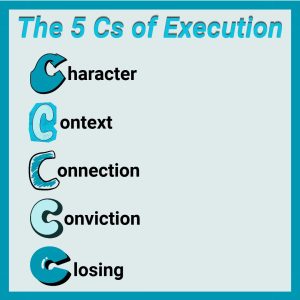 Character— Does the program build the mindset, discipline, and accountability that drive consistent behavior, not just event-day motivation?
- Context— Does it teach reps to understand the buyer’s world, pressures, goals, and internal constraints before pitching a solution?
- Connection— Does it develop the skills to build genuine trust quickly, especially in low-touch, digital-first environments where rapport is harder to establish?
- Conviction— Does it give reps a deep enough belief in the value they’re delivering to hold their ground through objections without folding on price?
- Closing— Does it treat closing as the natural outcome of a well-run process, not a high-pressure tactic bolted on at the end?
Context and Connection deserve particular attention today. When buyers self-research before engaging, reps lose the early-stage touchpoints that used to build familiarity organically. A program that doesn’t explicitly address how to establish credibility and relevance in a compressed window will leave your team struggling, regardless of how polished their pitch sounds.
It’s worth contrasting this with surface-level frameworks you’ll encounter during your search — generic checklists or “30-60-90 day plans” that describe training timelines rather than execution outcomes. Those tools aren’t wrong, but they describe when training happens, not what it actually changes in rep behavior after the training is done. The 5 C’s prompt a more useful question: After this program, can your reps execute better across every stage of a real sales conversation?
That’s the standard worth holding training providers to. It leads directly to a deeper issue most organizations haven’t fully confronted yet — what happens when your execution depends on one or two people who happen to be exceptional?
Why You Must Prioritize Systems Over Hero Performers
The most dangerous person on your sales team today is your top performer — because the day they leave, they take your primary revenue playbook and relationships with them.
This is the “Hero Performer” trap, and it’s more common than most sales leaders want to admit. When one or two reps consistently outperform the rest of the team, it feels like a win. But what you’re actually looking at is a fragile, unscalable revenue model built on individual talent rather than repeatable process.
The real measure of effective sales training isn’t whether it creates a superstar. It’s whether it raises the floor — making your average rep perform closer to your best rep, consistently, without heroics. That’s what a system does. When you’re evaluating any sales training agency or provider, the central question you need to ask is this: are they delivering a transferable framework, or just a collection of tactics that live inside a binder nobody opens after week two?
“A set of tactics makes a rep more effective today. A framework makes your entire sales organization more effective indefinitely — regardless of who’s on the team.”
Only 11% of sales organizations successfully drive commercial results during a transformation, according to Gartner. That number alone should reframe how you evaluate every training investment you’re considering. The organizations that don’t make it into that 11% almost always share one trait: they invested in instruction without building a system that outlasts the training event itself.
The Unstoppable Sales Machine Framework, including implementation coaching and advisory support, which accompanies the Unstoppable Sales Suite of programs, is built on this principle—creating a predictable, scalable revenue engine that doesn’t collapse when a top rep accepts a competing offer. When you’re choosing sales training, look for a provider who can show you the operating system beneath the skills, not just the surface-level techniques. That distinction is where durable commercial performance actually starts — and it leads directly to the question of what real ROI from reinforced training looks like.
The ROI of Reinforcement: What to Look for in a Provider
Most sales training courses fail the ROI test not because the content is wrong, but because the provider stops at instruction and never touches implementation.
The difference matters more than most sales leaders realize. Instruction delivers information. Implementation embeds behavior. When you’re vetting a training provider, the core question isn’t “what will they teach?” — it’s “what will they install?”
Here are four vetting questions to ask every provider before you sign:
- Do they offer post-training reinforcement? Coaching, manager check-ins, and structured accountability loops signal a provider built for behavior change, not just content delivery.
- Can internal managers get certified to sustain the framework? Licensing and certification programs let your frontline managers carry the methodology forward without depending on the vendor indefinitely.
- Will they customize to your actual sales cycle? Off-the-shelf programs map to generic buyer journeys. Your buyers aren’t generic — the framework shouldn’t be either.
- How do they define and measure success? Providers focused on execution track pipeline conversion, deal velocity, and rep consistency — not training completion rates.
Effective sales training delivers a 353% return on investment — but only when reinforcement is built into the model. That ROI erodes fast when reps attend a workshop, return to their territories, and slip back into old habits within 90 days.
The Unstoppable Sales Machine Framework addresses this directly. The licensing layer is critical — it means the framework lives inside your organization, owned and reinforced by your own managers, not rented from an outside vendor who moves on to the next engagement.
And that distinction sets up an important next point: even the most robust reinforcement model has to contend with a sales environment that’s shifting under everyone’s feet.
Adapting to the Modern B2B Sales Environment
Modern B2B buyers arrive at sales conversations already informed — which means the sales rep who leads with information delivery has already lost the room.
The shift is real and measurable. Today’s buyers complete a significant portion of their research before ever speaking with a salesperson, which changes what sales effectiveness actually looks like.
A traditional sales training workshop built around product knowledge and pitch rehearsal simply doesn’t match the reality your reps face. Buyers don’t need a brochure read aloud to them. They need a sales professional who can add perspective, challenge assumptions, and guide a decision.
Old way vs. new way: The old model treated sales conversations as information transfer — rep talks, prospect listens, close happens. The new model treats the conversation as a value exchange. Your reps need frameworks that help them ask the right questions, surface unspoken concerns, and position your solution against a backdrop the buyer already partially understands.
“Most sales training jumps straight to scripts, ignoring the underlying execution framework.” — Kevin Kelly
 That quote captures the core problem. Scripts assume a linear buyer journey. Frameworks account for variability — different buyer maturity levels, different objection patterns, different digital-first entry points. When a prospect has already consumed your competitor’s content before the first call, a scripted rep is flat-footed. A rep trained on a sound execution framework adapts in real time.
Sales technology and AI tools support this shift, but only when they’re built into the execution layer — not bolted on as separate initiatives. CRM hygiene, AI-assisted call analysis, and digital engagement tracking are most valuable when they reinforce a consistent framework rather than exist as standalone tools your reps ignore between training sessions.
When evaluating a provider, confirm they understand the digital-first sales cycle. That understanding shapes everything that follows — which sets up the broader question of how to choose the right partner overall.
Summary: How to Choose Your Next Sales Training Partner
Choosing sales training comes down to one question: does the program hand you a sales execution framework you can run every day, or does it hand you a binder you’ll forget by the end of the week?
The distinction matters more than most buyers realize before they sign a contract. Here’s what to verify before you commit:
- Execution framework over event. A one-off workshop produces a temporary lift, not a lasting change. Prioritize providers that deliver a structured, repeatable system your team can use in every sales cycle — not just a two-day curriculum that ends when the trainer flies home.
- A documented reinforcement plan. Ask directly: what happens at 30, 60, and 90 days post-training? If the provider can’t answer that question with specifics, the program likely stops at instruction. Behavior change requires spaced repetition and accountability built into the delivery model.
- Elimination of hero dependency. If revenue still runs through your top two reps after implementation, the system hasn’t worked. The right framework creates consistent, replicable performance across the team — not an improved top performer surrounded by the same struggling middle tier.
- A measurable ROI path. Demand to know which metrics shift and when. Pipeline velocity, conversion rates, and average deal size should move within a defined window. Systemic changes produce trackable outcomes; vague “skill development” rarely does.
What you’re really evaluating is whether a provider helps you build a machine or delivers another training moment. The next section makes that distinction concrete.
Beyond Training: Building Your Unstoppable Sales Machine
“Sales Training Doesn’t Fail. Sales Execution Breaks.” —
And until you fix the execution layer, no new course or curriculum will move your sales training ROI in a meaningful direction.
The execution gap is where most training investments quietly die. Reps leave workshops with frameworks they can’t apply, managers lack the tools to reinforce new behaviors, and within 90 days the organization is back to relying on its top performers to carry quota. That pattern doesn’t change by buying better content. It changes by implementing a better system.
The Unstoppable Sales Machine Framework is built specifically to close that gap. Rather than delivering training as an event, the Unstoppable Sales Suite embeds a structured, repeatable execution framework into your existing sales operation—one designed to produce measurable revenue outcomes without depending on heroic individual effort.
Long-term sustainability is where the Certified Implementor program adds compounding value. Whether you’re a VP of Sales building internal capability or an independent consultant looking to deliver a proven system to your clients, the Certified Implementor program gives you the tools, methodology, and licensing rights to sustain execution across the organization — long after any initial engagement ends.
Before you invest in another program, audit where execution is actually breaking down. Identify the specific moments in your sales cycle where deals stall, behaviors drift, or pipeline visibility disappears. That audit is the starting point — and it’s where Unstoppable Sales Machine, including implementation consulting, the Unstoppable Sales Suite of programs, and a Certified Implementor licensing program, begins. Request your free Unstoppable Sales Assessment to identify your execution gaps and find out what a systematic framework can do for your revenue results.
© Shawn Casemore 2026. All Rights Reserved.
Share This Article
Choose Your Platform: Facebook Twitter Google Plus Linkedin