

The Execution Gap: Why Great Training Fails to Scale
Every quarter ends the same way. Two reps carry the number. The rest of the team hovers somewhere between 60 and 80 percent of quota, and the forecast gets rebuilt around whoever happens to be hot. That dependency on hero reps isn’t a talent problem. It’s an architecture problem.
Sales training itself doesn’t fail. Sales execution breaks because leaders keep mistaking a methodology for a system.
A methodology is the art of the conversation — how a rep frames discovery, handles a pricing objection, or builds urgency with a CFO.
The problem is what happens after the workshop ends. Behaviors that reside solely in a rep’s memory can decay within weeks.
A sales system is the science of execution: the infrastructure that forces those behaviors to happen whether or not anyone remembers the training. Hero performers exist because they’ve developed personal systems in their heads and notebooks. They’re a symptom of an organization that never built one centrally.
Sales system architecture bridges the gap between what your team learned and what they actually do.
Defining the 2026 Sales System Architecture
Sales system architecture is the deliberate integration of technology, data, and process into a single model that produces the same rep behavior across the sales team regardless of tenure, territory, or motivation. It’s not a tech stack – it’s the system that the tech stack supports.
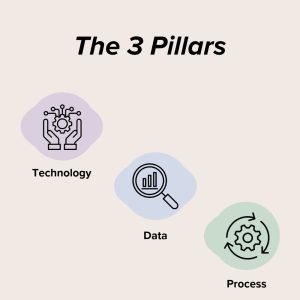 Three pillars for any successful sales architecture:
- Technology: CRM and AI tools that prompt, record, and enforce the next step or action — not a database reps update on Friday afternoon to keep management quiet.
- Data: Informed decisions applied to pipeline: stage conversion rates, deal velocity, activity-to-outcome ratios. This is what turns coaching from opinion into diagnosis.
- Process: The framework that defines entry and exit criteria for every pipeline stage, so “qualified” means the same thing to every rep.
One of the biggest shifts in these pillars has been the adoption of AI. 70% of sales professionals in high-performing organizations use AI for real-time selling advice and data-driven decision-making. This shift matters because it helps selling move away from intuition and toward applied data. The gap between teams using live guidance and teams relying on recall is widening fast.
The CRM’s primary role is pipeline management, not just record storage. High-performing sales organizations are 86% more likely to exceed their sales goals when using a CRM system to manage their pipeline.
The ROI of Predictability: Why Deal Structure Wins
Organizations with a formal, structured sales process experience 28% higher revenue growth than those without one. Here’s the reality: a formal, structured sales process means fewer deals stall in undefined pipeline stages, fewer opportunities get forecast on optimism, and fewer reps invent their own qualification standards.
Automation compounds this effect.
Companies that implement sales automation see a 14.5% increase in sales productivity and a 12.2% reduction in marketing overhead. Selling time returns to reps, and the work that used to eat Tuesday mornings—logging calls, chasing internal approvals, assembling proposals—stops consuming quota-carrying hours.
Sales Leadership Insight: Revenue growth from structure isn’t earned by adding activity. It’s earned by removing the friction that already exists inside your funnel. Audit where deals sit idle before you add headcount.
This also shortens the sales cycle. Every manual handoff—from BDR to Account Management, from Account Management to solutions engineer, from verbal agreement to signed contract—adds delay and creates opportunities for deals to drop off. Predictable revenue systems close these gaps by making the next step automatic rather than dependent on someone remembering to take it.
Build vs. Buy: Navigating the Sales System Dilemma
Most sales organizations don’t end up with a sales system intentionally. They build their system over time — a stage added here, a spreadsheet there — until the process is patched together. Nobody can explain it, so nobody follows it.
A better approach is to license an already proven framework, as shown in the chart below.
| Factor | Internal Build | Licensed Framework |
| Time to operational | 12–24 months of iteration | Deploys against a proven blueprint |
| Cost profile | Hidden: leadership hours, rework, turnover | Visible and budgetable upfront |
| Customization | Total, but often undisciplined | Configured within a tested structure |
| Scalability | Breaks when headcount doubles | Designed for onboarding at scale |
| Risk | Unproven until it fails in-quarter | Validated across other organizations |
Building makes sense when your motion is genuinely unusual, and you have a dedicated revenue operations function with the mandate to own it.
For everyone else, the speed-to-market advantage of licensing a proven sales execution framework is more desirable — you’re buying the architecture and spending your customization energy on the parts that actually differentiate you.
Operationalizing the Unstoppable Sales Machine
The distinction between sales methodology vs. sales system is where most sales training investments become sunk. Teams leave a two-day workshop energized, and within six weeks the old behaviors return because nothing in the daily operating rhythm changed.
The Unstoppable Sales Machine Framework was built around that failure point. It includes implementation consulting, the Unstoppable Sales Suite of programs, and a Certified Implementor licensing program — three components that exist because execution breaks in three different places: design, adoption, and reinforcement.
An implementation assessment addresses the architecture itself, mapping the behaviors your top performers already use and encoding them into stage criteria, cadences, and tooling. The Unstoppable Sales Suite converts those behaviors into programs the entire team can run, which is how an organization stops routing its number through two or three heroes and starts distributing performance across the roster.
The Certified Implementor licensing program exists because systems don’t stick on their own. Somebody has to own the reinforcement loop — inspecting behavior, correcting drift, and coaching against the framework rather than against instinct. For independent consultants and corporate trainers, it’s a licensed structure to deploy inside client organizations. For internal leaders, it’s how the system survives its first leadership change.
The Bottom Line: Transforming Sales into a Science
Methodology teaches your team what excellent selling looks like. System architecture guarantees it happens on a Tuesday afternoon when nobody’s watching. Leaders who invest exclusively in the first and neglect the second will keep buying training, keep seeing a short-lived lift, and keep rebuilding forecasts around whoever’s carrying the quarter.
 A sales system is the architecture — technology, data, and process — that makes a methodology repeatable across an entire team, not just among top performers.
- Structured, documented sales processes drive measurably higher revenue growth by eliminating the execution gaps where deals stall, slip, or die silently.
- Automation and AI guidance are baseline infrastructure for high-performing teams in 2026, not competitive extras — they return selling hours and replace opinion-based coaching with diagnosis.
- The build-versus-buy decision comes down to speed and scalability: build if your motion is genuinely unique and you own a revenue operations function, license a proven framework if you need predictability this fiscal year.
Sales stops being an art the moment the behaviors that produce revenue are designed into the operating model rather than left to individual discipline and hope.
Stop Training and Start Executing
Your team probably doesn’t need another sales methodology. Most sales organizations already have more training than they’re executing. The deficit is architectural — the system that would convert what reps know into what reps consistently do simply isn’t there.
- Run the diagnostic and be honest with yourself. Can you name the exit criteria for every pipeline stage?
- Does your CRM prompt the next action, or record it after the fact?
- If your strongest reps left in 90 days, what percentage of the sales target would still be reachable?
If those answers are uncomfortable, the gap isn’t in your people or your content. It’s in the layer beneath both.
Predictable revenue is systematically engineered. It comes from a machine that operationalizes A-player behaviors so they don’t depend on memory, motivation, or tenure.
Explore the Unstoppable Sales Machine Framework, including implementation consulting, the Unstoppable Sales Suite of programs, and a Certified Implementor licensing program, to build the system architecture your methodology has been waiting for.
© Shawn Casemore 2026. All Rights Reserved.
Share This Article
Choose Your Platform: Facebook Twitter Google Plus Linkedin