Framework
The Unstoppable Sales℠ Framework
Three pillars. Twelve components. One system for building a sales organization that performs without you in the room.
The Premise
Sales Is Not a Department
Most companies treat selling as something that happens inside one team. It doesn’t.
Your receptionist shapes a buyer’s first impression. Your operations group determines whether the promise made in the sale survives contact with delivery. Your finance team decides how a customer feels at the moment they pay you. Every one of those interactions moves a deal forward or quietly kills it — and none of them appear on a sales dashboard.
The companies that grow consistently aren’t the ones with the most aggressive sales team. They’re the ones where the entire organization understands its role in earning and keeping customers.
That’s the premise the Unstoppable Sales Framework is built on. The three pillars below are the mechanism that makes it real.
The Framework
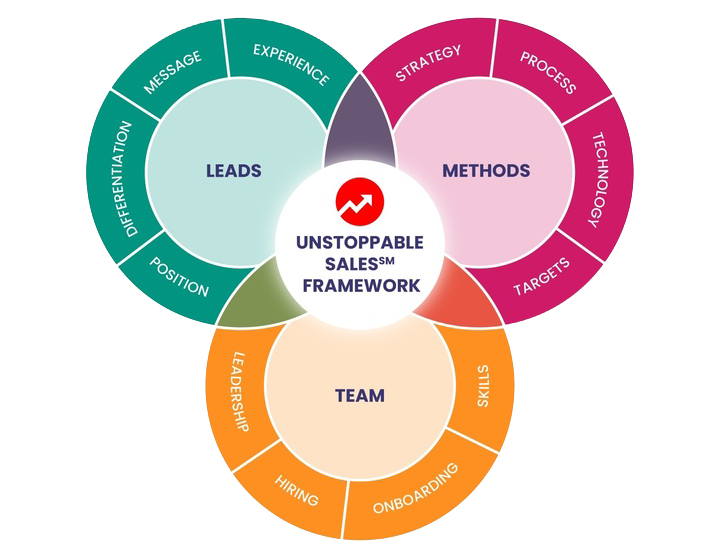
The framework has three pillars, each containing four components. Twelve in total.
Most organizations have invested heavily in one pillar and neglected the other two. A company with excellent lead flow but no effective methods converts only a fraction of what it should. A disciplined process delivered by an undertrained team produces activity without results. The framework is diagnostic, then prescriptive: it shows you which pillar is carrying the organization, which one is quietly costing you revenue, and what needs to start, change, or improve.
Leads
How buyers find you, and why they choose you over the competition.
- – Message: What you say, and whether it stops the right person from scrolling past.
- – Experience: What it feels like to become your customer, from first contact through close and renewal.
- – Differentiation: Why a prospect chooses you when the alternative looks similar on paper.
- – Positioning: Where you sit in the prospect’s mind before a conversation ever starts.
Methods
How selling actually happens, and whether it happens the same way twice.
- – Strategy: What you’re trying to win, and what you’ve decided not to pursue.
- – Process: The repeatable sequence a deal follows, and the criteria for moving between stages.
- – Technology: The tools that support the process — and the discipline to use only the ones that do.
- – Targets: Who you’re selling to, how you qualify them, and how you know when to stop.
Team
Who sells, how quickly they become effective, and how they improve.
- – Coaching: The ongoing, structured development of people who are already selling.
- – Skills: The specific selling capabilities your method requires, and whether your people actually have them.
- – Hiring: Who you bring in, and what you’re actually looking for.
- – Onboarding: How quickly a new hire becomes productive, and how much of that is left to chance.
How The Pillars Work Together
The pillars reinforce one another.
Strong lead flow into a team without a consistent method produces inconsistent results and no way to diagnose why. A disciplined method executed by a poorly coached team produces compliance without conviction. A capable, well-coached team with weak positioning spends its time defending price.
This is why fixing one aspect of your sales process rarely creates the sustained sales desired. Sales training alone, for example, can improve skills inside a broken process. A new CRM on its own can capture the wrong information.
The Unstoppable Sales Framework exists to identify which pillar is the actual constraint before you spend time or money attempting to fix what isn’t broken.
Where This Framework Came From
The Unstoppable Sales Machine (2022, Productivity Press) introduced eight components arranged around the buyer’s journey — Attention, Connection, Engagement, and Sale. Within each component are various subcomponents that work in conjunction with one another to build and accelerate unstoppable sales.
That model was right about demand. It has since evolved to capture the ongoing impact of AI, shifting buyer behaviours, and new proven methods of selling.
The updated framework includes: three pillars instead of one, twelve components instead of eight, and the original eight preserved as named tools inside the components where they belong.
Frequently Asked Questions
A system for building sales organizations that produce consistent, predictable revenue. It consists of three pillars — Leads, Methods, and Team — each containing four components, for twelve in total. It’s used by companies implementing it internally and by Certified Implementors delivering it to their own clients.
Leads — how buyers find you and why they choose you: Message, Experience, Differentiation, Positioning.
Methods — how selling happens and whether it repeats: Strategy, Process, Technology, Targets.
Team — who sells and how they improve: Coaching, Skills, Hiring, Onboarding.
Those are selling methodologies — they govern how an individual salesperson conducts a conversation or qualifies an opportunity. The Unstoppable Sales Framework operates a level above that. It addresses the organizational system around the selling motion: lead generation, process design, team capability, and the culture that determines whether anyone outside the sales department sees themselves as part of the effort. A company using Challenger or MEDDIC would locate it within the Methods pillar and still need the other two.
Sales leaders and executives at organizations with an existing sales team of more than four people, who are experiencing inconsistent results rather than a total absence of them. It’s also licensed by consultants, coaches, and corporate trainers delivering it under the Certified Implementor program.
Solo founders without a sales team, and organizations looking for a single training event rather than a system. The framework requires implementation over months, not a day.
12–24 months for a full implementation across all three pillars. Most organizations begin with the pillar identified as their primary constraint, which typically takes 6–12 months.
Yes. The Enterprise License certifies two or three of your internal enablement or sales leadership people to deliver the framework inside your organization, with materials, updates, and support included on an annual renewal.
The investment varies depending on the degree of implementation. Full details can be found on the licensing page.
Find out which pillar is costing you revenue.
The Unstoppable Sales Assessment scores your organization across all twelve components and shows you where the constraint actually sits.
Implementing internally? Explore the Framework →
Delivering to your own clients? License the Framework →