

Tell me if any of this sounds familiar. You invest in a two-day workshop, the team leaves energized, and six weeks later the pipeline looks exactly as it did before. Nothing was wrong with the content. What broke was everything that happened after the workshop ended.
A technique is a behavior one person performs in one conversation. An execution framework is the structure that makes that behavior mandatory, observable, and repeatable across every rep, every deal, and every quarter. Training teaches the first. Only a system produces the second.
Sales training doesn’t fail. Sales execution breaks.
That break is expensive because buying has gotten harder to manage informally. B2B buyers now move through an average of 10 touchpoints before they purchase, 30% of buyers consider GenAI a meaningful interaction in the final purchase stage, and 69% of B2B buyers want sales reps to validate AI-generated insights.
No individual rep can hold that complexity together through instinct alone, which is precisely why organizations default to hero performers who somehow manage it anyway.
The Unstoppable Sales Machine Framework removes that dependency and replaces it with a system your entire team can run.
Modernizing the Seven Steps of the Sales Process for 2027
The seven steps of the sales process everyone learned — prospecting, qualification, presentation, handling objections, closing, and follow-up — still describe the shape of a deal. What’s changed is that buyers no longer move through those steps in your order. They self-educate, consult AI tools, poll peers, and arrive mid-process with opinions already formed. B2B buyers now use an average of 10 touchpoints during a purchase, and most of those touchpoints happen without a rep in the room.
A sales execution framework that 2027 buyers will actually tolerate treats each stage as a validation checkpoint, not a sequential gate. Closing stops being an event at the end and becomes the cumulative result of value confirmed at every step:
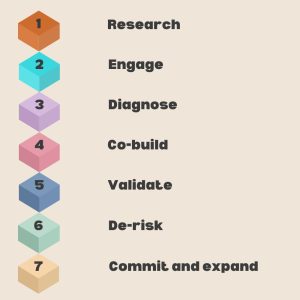 Research — map the account’s trigger events before first contact
- Engage — open with a point of view, not a capabilities pitch
- Diagnose — qualify the current impact cost(s), not just the budget
- Co-build — develop the solution with the internal buying team
- Validate — verify claims the buyer and team have gathered elsewhere, including from AI
- De-risk — address the implementation fears behind the stated objections
- Commit and expand — secure the decision and the next one
Consultative Selling vs. Solution Selling: Choosing the Right Approach
The consultative selling vs. solution selling debate usually gets framed as a choice. It isn’t. Consultative selling is diagnostic and relationship-first: the rep asks deep questions, uncovers goals and costs of inaction, and earns the right to recommend. Solution selling moves faster and more narrowly, matching a defined offering to a defined pain point the buyer has already named.
Both work, and both can fail for the same reason — they depend entirely on the individual rep’s judgment about which mode a given conversation requires.
Buyers no longer need you to inform them. They need you to confirm what they already think they know.
That shift is measurable. 69% of B2B buyers want sales reps to validate AI-generated insights, which places the rep in a role neither methodology was originally built for. The buyer arrives with a hypothesis; your rep either strengthens it, corrects it, or loses credibility.
The practical answer is a hybrid governed by a system: consultative depth during diagnosis, solution precision during validation, and a documented standard that tells every rep which move the deal stage calls for.
How to Sell Value, Not Price, in a Competitive Landscape
Price objections are rarely about price. They’re about a buyer who can’t articulate the difference between your offer and the cheaper one, so they default to the only variable they can compare cleanly. Learning how to sell value, not price, starts with giving them a better comparison.
Quantify the cost of inaction. Before discussing your fee, establish what the problem costs per month in lost deals, wasted rep time, or delayed cycles. A number the buyer supplies is a number they’ll defend internally on your behalf.
Link every feature to a named business outcome. “Automated pipeline reviews” means nothing. “Your managers stop spending Friday afternoons rebuilding forecasts by hand” means something. Value Validation is the discipline of never letting a capability travel without its consequence attached.
Prepare to be audited by AI. 30% of buyers consider GenAI a meaningful interaction in the final purchase stage, which means your value claims are being stress-tested against synthesized market summaries before the contract reaches legal. Vague differentiation collapses under that scrutiny. Specific, verifiable outcomes survive it.
Improving Sales Team Performance Through Systemic Consistency
Search results are saturated with sales techniques for beginners. Very little addresses what leaders actually need: a way to make strong technique the organizational default rather than an individual trait.
That’s the real work of improving sales team performance. When your top two reps produce half the revenue, you don’t have a talent problem — you have an undocumented process living inside two people’s heads. Promote one, and you lose the territory. Lose the other, and you lose the quarter.
Execution often breaks where training ends and the CRM begins.
The Unstoppable Sales System closes that gap by installing the framework where work actually happens. Stage definitions, qualification criteria, discovery question sets, and validation checkpoints get built into the system of record, so the right behavior is the path of least resistance rather than a memory exercise.
Certified Implementors carry that further. Rather than delivering content and leaving, an Implementor configures the framework against your pipeline, trains managers to coach to it, and establishes the measurement cadence that tells you whether execution is holding. Hero reliance becomes process reliance, which is something you can hire against, coach against, and scale.
The Bottom Line: Building Your Sales Machine
What separates organizations with predictable revenue from those riding quarterly swings comes down to a handful of principles.
- Execution is the differentiator, not technique. Competitors have access to the same methodologies, the same tools, and increasingly the same AI assistants. The advantage belongs to whoever institutionalizes execution first.
- Systems outperform talent at scale. A good rep inside a strong system beats a great rep inside no system, because the first outcome is repeatable across fifty territories and the second isn’t.
- Modern buyers demand validation, not information. They arrive researched, AI-assisted, and skeptical. Reps who can confirm, correct, and contextualize what buyers already believe earn the deal; reps who recite capabilities don’t.
- If it isn’t measured, it isn’t a framework. Defined stages, documented criteria, and manager coaching cadences are what turn training content into operating standards. Everything else is a motivational event with a budget line.
Building the machine means accepting that revenue predictability is an engineering problem, not a motivation problem.
Moving From Training to Transformation
 Sales training doesn’t fail. Execution breaks — usually somewhere between the last slide of the workshop and the first Monday morning pipeline review. Organizations that fix this stop asking whether their reps know enough and start asking whether their system makes the right behavior unavoidable.
Start by auditing your own machine. Can a new rep find the qualification criteria without asking a colleague? Do your stage definitions describe buyer actions or internal optimism? Can a manager coach a deal using the same standard across every territory? If the answers depend on who you ask, you’re running on hero performers and hoping they stay.
Take the free Unstoppable Sales Assessment to identify where your execution is breaking, then decide which path — implementation or licensing — fits what you’re building.
© Shawn Casemore 2026. All Rights Reserved.
Share This Article
Choose Your Platform: Facebook Twitter Google Plus Linkedin